What Needs to Be Fixed in the World
This story was originally published past Mother Jones and is reproduced here as part of the Climate Desk collaboration.
As the United Nations convenes in New York this calendar week for its 70th Full general Assembly, one of the most prominent items on the schedule is to formally sign off on its brand-new Sustainable Development Goals. The SDGs, which have been in the works for a few years, are basically a to-do list for all the earth'south governments from at present until 2030. They're also a seemingly impenetrable pile of diplo-jargon.
"If yous were to pick upwardly the certificate, your starting time reaction could exist that information technology's a lot of 'apathetic blah apathetic,'" said Peter Hazlewood, managing director of evolution at the World Resources Constitute.
Still, the SDGs could have a significant affect on the resource allotment of resource to fight climate change and other ecology problems over the next decade. Hither'southward what you need to know.
Replacing the Millennium Development Goals. The SDGs are a follow upward to the Millennium Development Goals, enacted in 2000. There were eight specific MDGs, all targeted at different aspects of extreme poverty: Reduce the child bloodshed rate by two-thirds, vastly expand admission to clean drinking h2o, turn the tide against HIV/AIDS, etc. Of course, the goals aren't legally bounden. Instead, the point was to give developed-country governments and international financial institutions such as the Earth Bank a target to shoot at when they make decisions virtually how to spend assist dollars or invest in certain projects. It's a way of maxim: "We agree that these are the world'southward top priorities right at present."
The "nosotros" in that sentence was pretty controversial, since — according to lore, at least — the goals were drawn up behind closed doors in the U.Northward. basement past a grouping of elite diplomats. For that reason, it took years for a critical mass of governments to really rally behind the MDGs and kickoff to implement them. And even then, the they were sometimes criticized for being also narrow and non sufficiently focused on the root causes of poverty.
As of the terminate of this year, the MDGs volition have reached their expiration engagement. How well did we do on meeting them? So-so. Global poverty and childhood bloodshed take been greatly reduced; for example, between 1990 and 2015 the portion of people in developing countries living on less than $1.25 per twenty-four hours brutal from 50 per centum to xiv percent. Still, obviously, global poverty has non been eradicated. The U.N.'s own recent cess found many goals were un-met, especially with respect to gender equality and conflict refugee issues.
And even in the all-time scenario, information technology'south far from clear how much impact the MDGs really had on whatsoever of the issues they sought to address. During the same time menstruation, for example, China was developing speedily and opening upwards to international merchandise, which had a huge impact on lifting its citizens out of poverty — quite separately from anything the U.N. was doing. Just it'south safe to say that the MDGs loomed over budget conversations at agencies like USAID, and in that mode had a tangible impact on how the U.South. and other rich governments spent coin on aid.
The MDGs "were far from perfect, and you cannot attribute all progress to them," Hazlewood said. "But you can make a stiff case that they had a galvanizing outcome."
So what are the Sustainable Development Goals? This time effectually, while still including poverty, the focus has swung much more toward environmental issues, including climate change adaptation. Here are the 17 goals:
- Finish poverty in all its forms everywhere
- End hunger, achieve food security and improved nutrition, and promote sustainable agriculture
- Ensure healthy lives and promote well-being for all at all ages
- Ensure inclusive and equitable quality education and promote lifelong learning opportunities for all
- Accomplish gender equality and empower all women and girls
- Ensure availability and sustainable direction of water and sanitation for all
- Ensure access to affordable, reliable, sustainable, and modernistic energy for all
- Promote sustained, inclusive, and sustainable economic growth, full and productive employment and decent work for all
- Build resilient infrastructure, promote inclusive and sustainable industrialization, and foster innovation
- Reduce inequality within and among countries
- Make cities and homo settlements inclusive, prophylactic, resilient, and sustainable
- Ensure sustainable consumption and product patterns
- Take urgent activeness to combat climatic change and its impacts
- Conserve and sustainably use the oceans, seas, and marine resources for sustainable development
- Protect, restore, and promote sustainable use of terrestrial ecosystems, sustainably manage forests, combat desertification, halt and reverse land degradation, and halt biodiversity loss
- Promote peaceful and inclusive societies for sustainable development, provide admission to justice for all, and build effective, accountable, and inclusive institutions at all levels
- Strengthen the ways of implementation and revitalize the global partnership for sustainable development
If that seems like a lot, well, it is. While the MDGs were too narrow, the SDGs could very well exist too broad. As Michael Specter pointed out in the New Yorker, "goals such every bit 'End poverty in all its forms everywhere,' may seem so broad that they volition be easy to ignore." U.K. Prime Minister David Cameron said as much last year, alarm that with and then many goals, "there'due south a real danger they will end up sitting on a bookshelf, gathering grit." Fifty-fifty but reading the list seems overwhelming; imagine being a head of country trying to implement it in your sprawling national bureaucracy.
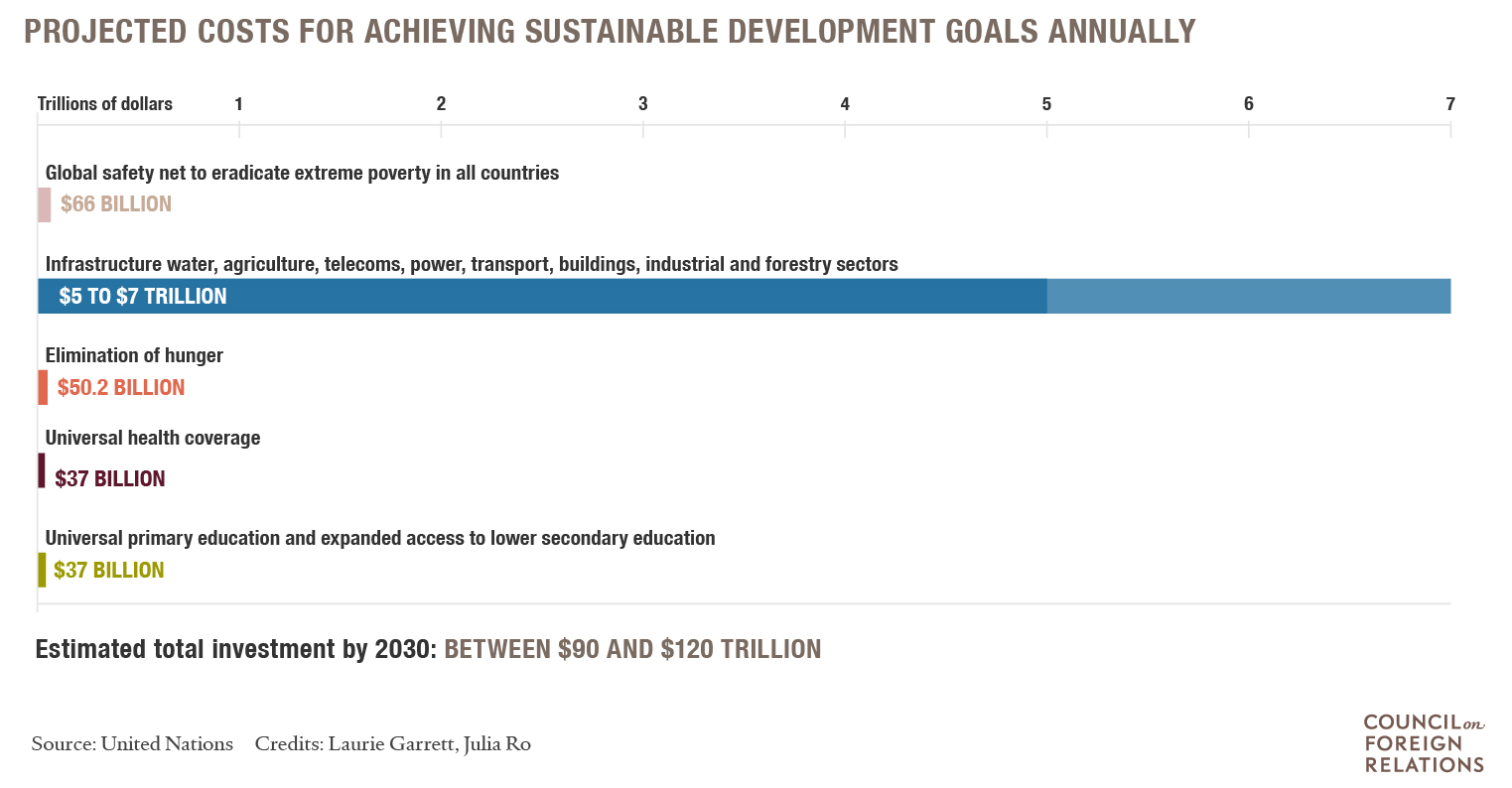
And they're non cheap: By some estimates, they could cost more than $seven trillion a year to implement, and there'due south nevertheless no clear consensus on where exactly that money will come from. It would likely be a mix of individual-sector investment; assist from the U.N. and developed countries; and increased spending past developing countries.
Council on Foreign Relations
At the aforementioned time, the goals' breadth could be a strength, equally less flush countries become more involved in implementing them — equally opposed to only beingness on the receiving terminate of aid dollars. They could provide an impetus for developing countries to get more than serious most things under their control, similar empowering women, or conserving natural resources, or making urban planning decisions with an eye toward climate impacts. At the very least, the goals provide armament for diplomatic peer-pressure level: No country wants to look lackadaisical compared to the one side by side door, or act in direct contravention of the goals, lest they scare off donors or investors. And information technology could be a mode for U.South. agencies to justify increased spending on climate adaptation.
"These are universal goals," Hazlewood said. "Information technology'south not but about what the U.S. should exist doing with countries in Africa; it's about what every country in the world needs to do."
What's side by side? Of grade, the U.Due north. can't compel any state to practice whatsoever of these things. And then the goals won't thing unless individual national governments have them seriously. Unlike the old MDGs, the SDGs were developed over several years with maximum transparency, involving a huge, diverse cast of governments, NGOs, and private companies. The rationale for that strategy was to increase everyone'southward stake in the goals, so that when they come into effect, countries volition swiftly incorporate them into national policy decisions — in other words, take them off the page and into practice. We'll have to wait and see if that volition actually happen.
"With the MDGs it took years to get whatsoever kind of traction and for countries to take them seriously," Hazlewood said. "But this time we can get the process off to a improve start."
Source: https://grist.org/climate-energy/here-are-17-things-we-need-to-do-to-fix-the-world/
0 Response to "What Needs to Be Fixed in the World"
ارسال یک نظر